Wednesday, September 28, 2016

Photo Manipulation and Ethics

A. Some of the main points on this website regarding manipulating images is that photos are now becoming easier to manipulate and they are able to hidden much easier. Photographs are art, journalism is informing the public. In order to satisfy both, certain rules of ethics must be broken. The photographer is an artist and wants to be known for their stellar works. Publications have a job to inform the public as fairly and as impartially as possible.

B. The philosophy of newspapers like the Washington Post and the New York Times are that pictures should not be manipulated. They combat this by enforcing rules like all pictures must be turned in to prove that pictures aren't manipulated, and that that they trust the photographers to turn in unaltered pictures and they trust journalists to turn in unaltered stories.

C. I believe that not much can be done to a picture and still be ethical. Technically all alterations to a picture are unethical in the world of photojournalism.


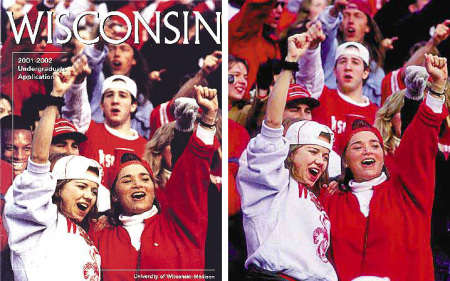
D. I think that this picture is unethical because it places a false advertisement to the public. The University of Wisconsin is trying to break free of their racial issues by manipulating their photo and that is not okay.


E. I think this picture is least unethical because although the color manipulation was dramatic. The picture just shows a fire fighter on a ladder, it doesn't change the fire fighter or his actions in any way. The picture is pure art, and with the context I was given, I drew the conclusion that this picture was used for art and not for journalism.


DSLR Camera

Aperture Settings: 2.8, 3.5, 4, 4.5, 5.6, 6.7, 8, 9.5, 11, 13, 16, 19, 22
Shutter Speed: 1-1/4000 seconds
IOS Settings: 100, 200, 400, 800, 1600, 3200, 6400, 12800, 15600

Academic Shoot Reflection and Critique

1. Challenges that occurred while I was taking these photos was that it was hard just to find academic things to take photos of in our limited time. I also thought that when we did find a good subject, it was hard to work around the classroom and all of the people in it to get a good shot.

2. I thought about the angle of the photo the most. One photo where I believed that I did it really well was in my simplicity photo, I got just the right angle so that there was nothing on the wall behind my subject.

3. If I could redo the assignment then I would make my subjects more clear and focused.

4. I think that if I were to do this again then I would keep the angles in which I took the photo.

5. I think that simplicity will be the easiest rule to preform correctly.

6. I think that the hardest rule to preform correctly will be the rule of lines.

7. I am not totally clear on the rule of mergers. I think that I can go back and look at correct examples that other people have and learn from them.

http://gailsphotojournalismblog.blogspot.com

Feed back:
1. Most of her subjects are very clear.
2. The focus is very clear on her subjects, and she blurred the background perfectly.
3. I think that she should have made her subject more clear in her rule of thirds photo.

Monday, September 26, 2016

ISO


ISO 200

1. It would be better to shoot a basketball game or football game with a higher ISO so that your photo would not be blurry.
2. The author suggested that you should uses low ISO when there is a lot of light so that the detail will stay high quality.
3. The author said that you should use high ISO she there is not much light, or you are not using flash.


Shutter Speed

At the Beginning:
a) medium shutter speed
b) medium shutter speed
c) fast shutter speed
d) fast shutter speed
e) medium shutter speed
f) slow shutter speed

At the End
a) slow shutter speed
b) slow shutter speed
c) fast shutter speed
d) medium shutter speed
e) medium shutter speed
f) medium shutter speed

Settings
1. Aperture Priority is when the camera sets the shutter speed and you set the aperture.
2. Shutter Priority is when the camera sets the aperture and you set the shutter speed.
3. Manual is when you set both the shutter speed and the aperture.

Aperture

F2.8
F16
1. Aperture should be closely related to the human eye.
2. The smaller the aperture the more light gets let in, the larger the aperture the less amount of light gets let in. 
3. Aperture impacts Depth of Field because the smaller aperture, the less of the background that you can make out.